
Is Puppy's Visual World Different From Yours?
It is highly important to understand how dogs see the world. Many aspects of dog training and mentally engaging activities rely heavily on their sense of sight, making it essential to comprehend their visual perception.
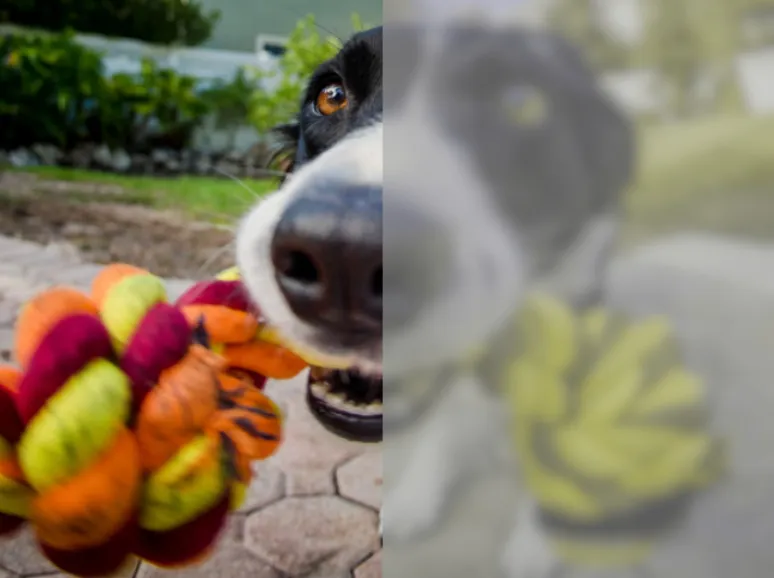
1. Color Vision
Dogs can see colors, but not the same range as humans. Humans have three types of cones sensitive to blue, green, or red light, while dogs have only two cone types (blue and red), similar to some people with red-green colorblindness.
As a result, dogs primarily perceive yellow and blue, along with combinations of those colors, making much of the world appear grayish-brown. A lush green lawn looks like a field of dead hay to a dog, and a bright red velvet cushion probably appears as a dark brown blob.
2. Binocular Vision
The binocular field—the area seen by both eyes—enables depth perception. Each eye provides a slightly different perspective, and the brain processes these differences to judge distance.
In dogs, the binocular field is reduced to 80–100 degrees, compared to 140 degrees in humans, due to the lateral position of their eyeballs. Some breeds have better depth perception than others, depending on eye position and skull shape, which means some dogs may misjudge distances more often.
3. Visual Field
Dogs have a wider visual field than humans, ranging from 150 to 240 degrees, depending on eye position, ear shape, snout length, and fur length. This allows them to scan the horizon more effectively without turning their heads.
4. Motion Vision
Both dogs and humans are more sensitive to moving objects than stationary ones. Dogs can detect a flickering light at 75 times per second, while humans can only detect up to 60 times per second. Because of this, dogs may perceive television screens—refreshed at 60 Hz—as flickering motion rather than continuous motion.
5. Dim Light Vision
Dogs have many more rod cells than humans, making their eyes specialized for low-light vision. Their wild ancestors were crepuscular (active at dawn and dusk), and dogs have retained this ability to detect movement in dim light, while also adapting to daylight conditions.
6. Eye Aging
Dog eyes age faster than human eyes. They experience lens thickening, hardening, and clouding, likely due to ultraviolet sunlight damage, leading to blurrier vision. Dogs are also prone to cataracts, macular degeneration, and glaucoma.
Unlike humans, who become more long-sighted with age, dogs become more near-sighted, making distant objects blurry.
7. Visual Perspective
Humans typically stand 165–180 cm tall, while dogs range from 15–110 cm at the shoulder. This means dogs focus more on the ground, which can cause navigation challenges in tall vegetation. Dogs with longer snouts may have additional difficulty looking down, as their snouts obstruct vision, requiring them to lower their entire head to see the ground.
8. Top Tips For Considering Dog's Vision
By understanding these visual differences, we can improve training methods and deepen our bond with dogs. A clearer grasp of how dogs perceive the world allows us to navigate their unique needs with empathy and insight, fostering stronger connections and enriching the shared journey between humans and dogs.